


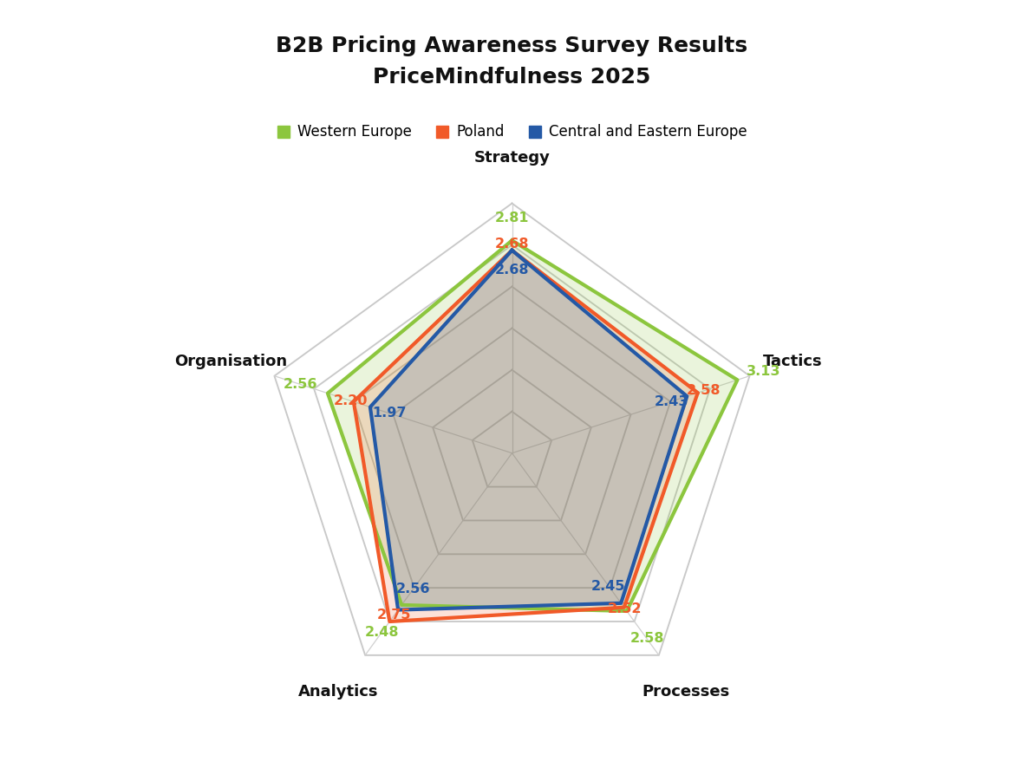
A significant shift is under way in Polish B2B. Price is becoming less and less a lever for salespeople to “deliver results” and increasingly a tool for consciously managing profitability and a key element of business strategy. With an average score of 2.55 on the five-point PriceMindfulness scale, Polish companies are beginning to stand out positively in Central and Eastern Europe (average: 2.41) and are closing the gap with Western Europe (2.71).
After ten years in business, we are seeing a dynamic rise in awareness among Polish enterprises of strategic revenue management across pricing, discounts, promotions and product portfolios. Although we operate from the heart of Warsaw, until recently the vast majority of our clients were companies from the United States and Western Europe.
Recently, more and more Polish companies, particularly those operating internationally, have been approaching us. Some already have a sound strategy and the right pricing expertise in-house, but are looking to digitise their operations to scale processes and improve efficiency. Others seek advisory support to establish the rules of their pricing and discount policy and implement processes that ensure it is consistently enforced.
Training is the third area of our growth, alongside strategic advisory and technology implementation. We deliver it both directly and through partners. In our market, it is still not uncommon to encounter owners and senior executives of large companies who speak, for example, of two hundred percent margins or of building a strong brand by always being the cheapest on the market. Unfortunately, neither a gold iPhone nor a Lamborghini will spare anyone embarrassment in a business meeting, but the knowledge gained through our training can. A high level of expertise across Polish business matters to us, which is why we treat market education more as a mission than as another pillar of our business.
Quo vadis, pretium?*
Strategic pricing management is the area in which European companies are most closely matched. More pronounced differences become visible at the level of the individual topics that make up this area. Polish companies achieve an average score as much as 20% higher in successfully aligning pricing strategy with brand and product lifecycles. They also do not lag far behind in the use of market segmentation, price-pack architecture and value chain management. What is seriously lacking, however, is the definition of strategic pricing objectives for positioning prices against competitors. Multi-year roadmaps and long-term forecasting models are also rare, with scores as much as 41% below Western Europe. This stems from Polish companies’ strong focus on short-term action. On the one hand, this goes hand in hand with business dynamism and a high capacity to adapt to changing market conditions. On the other hand, the lack of a long-term vision often results in operational chaos.
Trust, but verify
Pricing tactics, meaning the rules governing day-to-day activity, are where the largest gap between East and West emerges. While customer categorisation and skilful management of retrospective rebates are familiar to Polish companies, standards for setting and enforcing pricing corridors and system-based approval of special prices are as much as one-third less mature than in Western businesses. The same applies to upselling and cross-selling techniques, which also require consistent rules and a systematic, process-driven approach to succeed. Strengthening the tactical area offers the greatest potential for rapidly improving profitability by eliminating uncontrolled margin leakage and cross-channel conflicts, which arise particularly often at the intersection with e-commerce.
The destination matters less than the journey
The comparison in terms of pricing process maturity is particularly interesting. Polish organisations trail Western Europe by 10 to 15% when it comes to structured reviews of pricing and discount policies and regular research into customers’ willingness to pay and price sensitivity. An even wider gap of 24% appears in equipping sales teams with pricing arguments, in other words, training them to sell on value rather than discounts. On the other hand, Polish businesses manage the implementation of broad-based price increases more effectively, by 5% on average, and take a more structured approach to commercialising new products.
Polish companies stand out particularly positively in the maturity of their competitive monitoring processes: they score 26% above Western Europe and just 2% above other Central and Eastern European (CEE) countries, revealing a fundamental difference in regional approaches. It is worth noting that this clear market advantage has two sides. CEE companies demonstrate greater courage and commercial aggressiveness, which drives growth, but they pay less attention to ensuring that market intelligence processes comply with competition law. The circulation of photographs of customers’ purchase invoices and competitors’ price lists via corporate email is unfortunately still fairly common. Western European companies, statistically larger and therefore more closely scrutinised, have repeatedly faced painful interventions from national and EU competition authorities over the decades. This has led to a level of caution that is often excessive today and to internal bans on any form of competitor monitoring.
Crystal ball 2.0
Analytics is the strongest area for Polish companies and, for now, the only one of the five areas studied in which they clearly outperform Western businesses, scoring 2.80 versus 2.56, a 13% advantage. Western organisations are often much older and have more complex structures, creating greater inertia in efforts to improve data management hygiene. In the age of AI, high-quality transaction data that provides transparency across the price waterfall, from the base list price through invoice-level discounts and promotions and customer-allocated variable costs to the margin that ultimately remains “in the company’s pocket”, is a significant competitive advantage. The key to success is using available resources effectively and building practical reports that support decision-making.
Building a business is a marathon, not a sprint
In terms of organisational capability maturity, Polish companies are almost as far ahead of the CEE average as they still lag behind Western Europe, around 13% in each case. The greatest opportunity for development lies in aligning sales incentive systems with pricing objectives and ensuring that pricing and discount policies can scale through modern tools that optimise commercial terms and automate quotation processes, an area where the score is 23% lower than in Western Europe. Revenue management itself also needs to be viewed more holistically by integrating pricing with product mix optimisation and trade spend effectiveness. The proportion of companies in Poland with dedicated people responsible for managing pricing, discounts and promotions is still more than one-quarter lower.
A compass for pricing
PriceMindfulness is PriceMind’s proprietary model for helping companies develop their B2B pricing capabilities. We created it based on proven Western frameworks, including World-Class Pricing by P. Hunt and J. Saunders and the Pricing Maturity Model developed by the EPP.
The PriceMindfulness model is tailored to the realities of Central and Eastern Europe and offers highly practical tools suited to the needs of manufacturing and distribution companies. It covers five areas: strategy, tactics, processes, analytics and organisation.
A free self-assessment questionnaire based on the model will soon be available on the PriceMind website. Using their responses, users will be able to generate a report that not only assesses the current state against market best practices but also benchmarks it against the average of other companies included in the study.
Author: Mateusz Kędziora, Pricing & Revenue Management Consultant
* Pretium (Latin) means “price”.